Introduction
There are many historical events captured in the form of stories in the Vedic scriptures that continue to inspire people even thousands of years later. Among them, the description of the appearance of Lord Krishna holds a special place in the hearts of millions of devotees. Every year, the festival of Janmashtami is celebrated with great enthusiasm and joy because it marks the divine appearance of Lord Krishna, who descended to establish dharma in the world.
Lord Krishna’s birth is not simply a tale of an extraordinary child born in adverse circumstances. It is a sacred narration, revealing how the Supreme Personality of Godhead, Lord Krishna, personally appears in this material world for giving pleasure to his devotees, to perform various sweet and wonderful pastimes which continue to inspire and attract wondering souls to him and to kill the miscreants and re-establish dharma, which can help guide living entities for acting in this world in such a way that they can go back to the spiritual world, back to Lord Krishna at the end of their lifetime.
For devotees of Lord Krishna (generally known as Vaishnava’s), Janmashtami is a festival and an opportunity to celebrate Krishna’s birth, and hear about his actions so that their loving attraction for Lord continues to grow. No matter how hard your circumstances become, the Lord will always be there to guide and protect you. Janmashtami is a remembrance of his compassion, his loving dedication to all the living entities whom he maintains without any discrimination. However, if we choose to become his devotees, he promises in the Bhagavad Gita that he will take special care of us.
Let us journey back to ancient Mathura and understand the birth history of Lord Krishna, events that led to His appearance, and why the history of Krishna Janmashtami continues to inspire devotees across the world.
Who is Lord Krishna? (Overview)
Millions worship Lord Krishna as the divine cowherd, the Supreme Personality of Godhead, who guides his devotees on the path of dharma. His story is primarily recorded in scriptures like Srimad Bhagavatam, Harivamsa, and Vishnu Purana.
People worship Krishna as the playful child of Gokul, the charioteer of Arjuna in the Mahabharata, and as a statesman in the form of Dwarikadhish. His appearance on earth had a far deeper purpose. As Lord Krishna Himself declares in the Bhagavad Gita (4.7-8):
“Whenever and wherever there is a decline in religious practice and a rise of irreligion, I manifest Myself.”
The Lord Krishna birth story begins at a time when fear had gripped the kingdom of Mathura. A cruel ruler had spread terror among his people, and even the righteous lived under constant oppression. It was then that the Lord chose to appear.
The Story of Krishna's birth reminds us that although darkness may seem overwhelming, divine grace always finds a way to restore hope.
Krishna, the original Supreme Personality of Godhead
In the Vaishnava tradition, Lord Krishna is recognised not merely as the eighth avatar of Lord Vishnu but as Svayam Bhagavan, the original Supreme Personality of Godhead from whom all other incarnations expand. This understanding is central to ISKCON’s teachings and is supported by the Srimad Bhagavatam (1.3.28), which declares:
“Krishnas tu Bhagavan Svayam.”
For the benefit of humanity, Krishna appeared in His original form while simultaneously fulfilling the role traditionally recognised as the eighth incarnation in the sequence of Lord Vishnu’s descents.
His appearance had several divine purposes:
- To protect His devotees from oppression.
- To end the tyranny of the wicked King Kamsa.
- To re-establish the principles of dharma.
- To reveal the beauty of loving devotional service, known as Bhakti.
- To bless the world with His transcendental pastimes.
This understanding gives deeper meaning to the history of Krishna Janmashtami. The festival celebrates not only the Lord’s appearance but also His eternal promise to guide those who sincerely seek Him.
Mathura under Kamsa’s Tyranny
In the time of the Yadu dynasty, the ancient kingdom of Mathura was living under fear of its tyrannical ruler, King Kamsa.
He had become increasingly arrogant and ruthless. Obsessed with power, he imprisoned or punished anyone he considered a threat. His subjects obeyed him out of fear rather than respect, and even people from his own family suffered under his rule.
Yet, despite his strength and influence, Kamsa could not escape destiny.
A single prophecy would soon change the course of his life forever.
The birth history of Lord Krishna begins against this backdrop of oppression, reminding us that when injustice reaches its peak, the Supreme Lord personally intervenes to protect righteousness.
The Prophecy that Sealed Kamsa’s Fate
The Story of Krishna's appearance takes a dramatic turn on what should have been one of the happiest days in Mathura.
Princess Devaki, the beloved sister of King Kamsa, had just been married to the noble prince Vasudeva. As was customary, Kamsa himself drove their chariot through the streets of Mathura to escort the newlyweds to their home. The city rejoiced, unaware that this journey would change history forever.
Suddenly, a divine voice echoed from the heavens:
“O Kamsa! The eighth son born to Devaki will be the cause of your death.”
As soon as the prophecy was heard, engulfed in fear and anger, Kamsa drew his sword to kill his own sister on the spot. Her husband, Vasudeva, intervened and reasoned calmly with the fearful king. He requested to spare Devaki’s life and promised that every child born to Devaki would be handed over to him. Convinced by Vasudeva’s sincerity, Kamsa lowered his weapon but imprisoned the couple instead.
What followed was a heartbreaking chapter in the Lord Krishna birth story. Determined to change his destiny, Kamsa killed the first six sons born to Devaki. The seventh child, Balarama, was divinely transferred from Devaki’s womb to that of Rohini (Vasudeva’s first wife) in Gokul. This child was born as Balarama - Krishna’s elder brother and protector.
The prophecy that terrified Kamsa became a reminder that no earthly power can alter the will of the Lord. The more Kamsa tried to avoid his destiny, the closer he unknowingly moved towards it.
Devaki & Vasudeva’s Imprisonment
Life inside the prison was full of sorrow, yet Devaki and Vasudeva kept their faith in the Lord.
Bound by iron chains and guarded day and night, they had every reason to despair. Still, they remained steadfast, trusting that the Lord’s plan would unfold at the proper time. Their unwavering devotion is one of the most touching lessons in the Krishna birth story.
The prison itself symbolised the suffering that often accompanies life in the material world. Yet even in those dark surroundings, hope remained alive because the Lord had promised to appear.
The scriptures describe that as the time of Krishna’s appearance drew near, extraordinary signs began to manifest. The hearts of the devotees became peaceful, the atmosphere grew auspicious, and the entire universe seemed to await a divine moment.
For devotees today, Devaki and Vasudeva represent complete surrender to Krishna. Their faith reminds us that although difficulties may arise, the Lord never abandons those who take shelter of Him.
The Miraculous Night of Krishna’s Birth
At the stroke of midnight, on the eighth day of the dark fortnight in the month of Bhadra, the long-awaited moment arrived.
Unlike ordinary births, the appearance of Lord Krishna was completely transcendental. The Srimad Bhagavatam explains that He first manifested before Devaki and Vasudeva in His magnificent four-armed form, adorned with the Kaustubha jewel, yellow garments, and divine ornaments. His complexion resembled a fresh rain cloud, and His radiance illuminated the prison cell.
Seeing the Supreme Lord before them, Devaki and Vasudeva folded their hands in prayer. They recognised that the child before them was none other than Lord Vishnu, the Supreme Lord Himself.
After accepting their heartfelt prayers, Krishna instructed His parents to carry Him across the Yamuna River to Gokul, where Nanda Maharaj and Mother Yashoda had just welcomed a baby girl. He then assumed the form of an ordinary infant, allowing His divine childhood pastimes to begin.
This moment forms the heart of the Lord Krishna birth story. It is remembered every year during Janmashtami with midnight worship, kirtan, and joyous celebrations in temples around the world.
Divine Signs at Midnight
The appearance of Lord Krishna was accompanied by extraordinary signs that reflected the sacredness of the occasion.
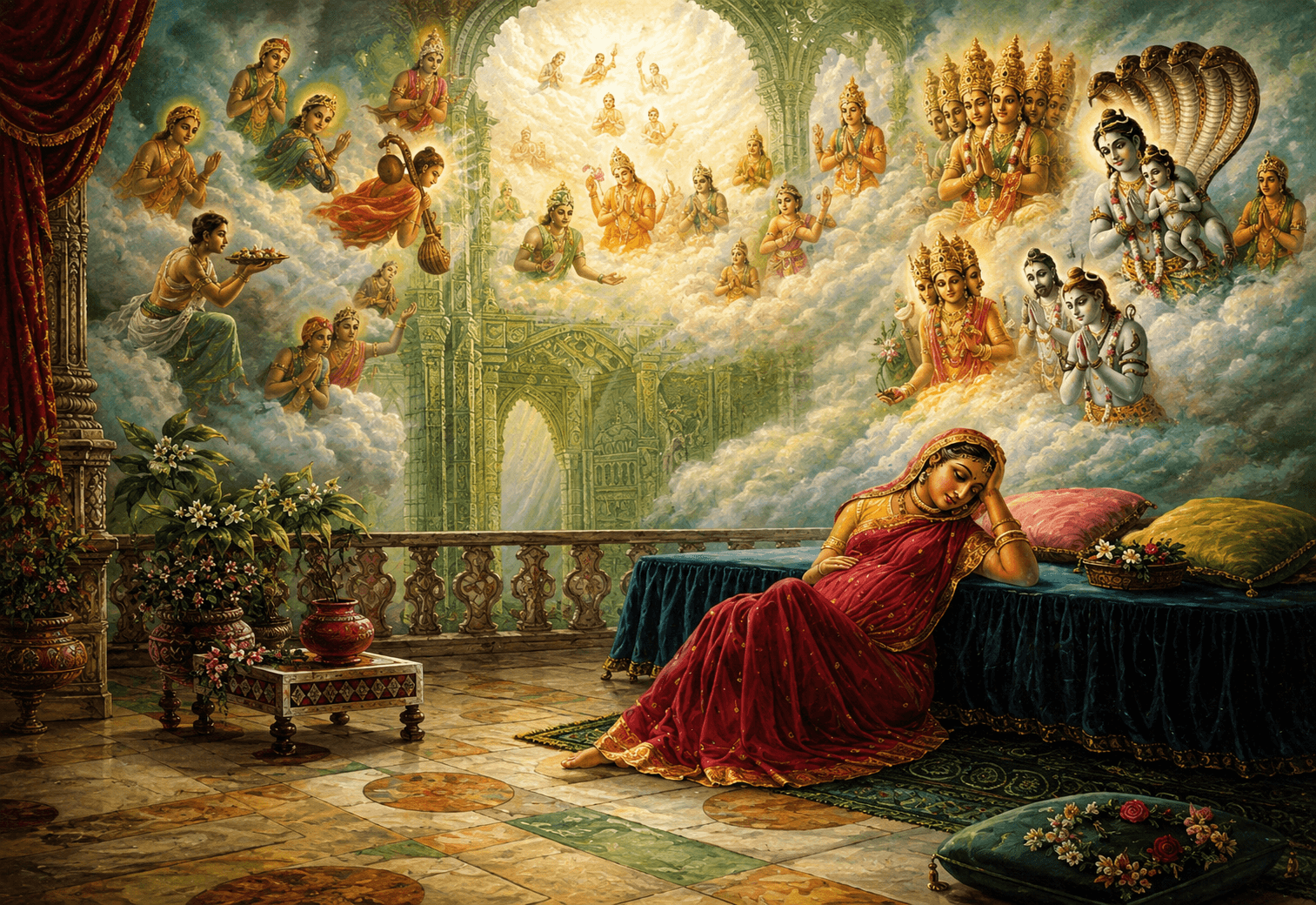
The Srimad Bhagavatam describes that the stars aligned favourably, gentle breezes carried a pleasing fragrance, rivers flowed peacefully, lakes bloomed with lotuses, and the entire atmosphere became serene. Even celestial beings rejoiced, showering flowers from the heavens and offering prayers to welcome the Supreme Lord.
Inside the prison, another miracle unfolded. The heavy iron chains binding Vasudeva fell away on their own. The locked prison doors opened effortlessly, and the guards who had been keeping watch fell into a deep sleep under the influence of Yogamaya.
Every obstacle disappeared, making way for the Lord’s divine plan.
These miraculous events are not merely dramatic episodes in the birth history of Lord Krishna. For devotees, they symbolise an eternal truth: when Krishna desires to protect His devotees and fulfil His purpose, no material barrier can stand in His way.
That very night, carrying the divine child safely in his arms, Vasudeva stepped out of the prison and began a journey that devotees have remembered with reverence for thousands of years.
Vasudeva’s Journey across the Yamuna to Gokul
With the infant Lord Krishna resting peacefully in his arms, Vasudeva stepped out of the prison, trusting every instruction the Lord had given him.
Outside, the night was unlike any other. Dark clouds filled the sky, rain poured relentlessly, and the Yamuna River flowed with great force. By all appearances, crossing the river with a newborn child would have been impossible.
Yet this was no ordinary journey. As Vasudeva walked towards the Yamuna, another divine miracle unfolded. The mighty serpent Ananta Shesha, the eternal servant of the Lord, appeared behind him and spread His many hoods like a royal umbrella, shielding baby Krishna from the heavy rain. The storm continued, but not a single drop touched the Lord.
When Vasudeva reached the banks of the Yamuna, the river was overflowing. Taking a deep breath, he stepped into the water, holding Krishna high above his head. The scriptures describe that the Yamuna, recognising the Supreme Lord, gradually made way for Him. The waters parted just enough for Vasudeva to cross safely.
Some Vaishnava commentaries beautifully explain that at one point the river gently rose to touch the lotus feet of baby Krishna, considering herself blessed by His divine presence.
Every moment of this journey reminds devotees that when one sincerely follows the Lord’s instructions, He personally removes obstacles that seem impossible to overcome.
Krishna’s Upbringing in Gokul & Vrindavan
By the time Vasudeva reached Gokul, the entire village was fast asleep under the influence of Yogamaya.
In the home of Nanda Maharaj and Mother Yashoda, a baby girl had just been born. Quietly, Vasudeva placed baby Krishna beside Yashoda, lovingly lifted the infant girl, and began his journey back to Mathura.
When he returned to the prison, the doors closed behind him, the chains reappeared, and the guards awoke as though nothing had happened.
Kamsa rushed to the prison upon hearing the cry of the newborn child. Believing the prophecy referred to this baby, he tried to kill her. But the child slipped from his hands and manifested as Yogamaya Devi in a brilliant celestial form.
She declared:
“The one who will end your tyranny has already been born elsewhere.”
For Kamsa, fear only deepened. For the devotees, the Lord’s divine childhood pastimes were about to begin.
This remarkable sequence of events forms an important chapter in the Lord Krishna birth story and sets the stage for the many enchanting pastimes that followed in Gokul and Vrindavan.
Raised by Yashoda and Nanda
Although Lord Krishna appeared to Devaki and Vasudeva in Mathura, He spent His childhood under the loving care of Mother Yashoda and Nanda Maharaj in Gokul.
It is this affectionate upbringing that gives Krishna's childhood pastimes their warmth and charm.
The land where Krishna spent His childhood is called Vrajabhoomi. To the people of Vraja, he was not any supreme being; he was their beloved child. Like all mothers, Mother Yashoda worried when He wandered outside, lovingly fed Him fresh butter, and gently scolded Him for His playful mischief. Nanda Maharaj protected Him as any caring father would.
Krishna’s relationships with the people of Vrajabhoomi are a unique aspect of Bhakti that’s cherished even today. They loved Krishna without knowing he was Supreme Lord himself. Their affection towards him stemmed from a place of pure love and was completely free of any expectations. To them, he was their Kanha - their friend, son, brother-in-arms.
As Krishna grew, He delighted everyone with His childhood pastimes, fondly called Krishna Leela. He crawled through the courtyards of Gokul, stole freshly churned butter from the homes of the gopis, played with the cowherd boys, tended calves, and filled the entire village with laughter.
Yet behind every Leela was a divine purpose. Time and again, Kamsa sent many demons to terrify Vraja and to kill Krishna, but he protected the residents by defeating them, including Putana, Trinavarta, Shakatasura, Vatsasura and many more.
Why this Story Matters - Spiritual Significance
The history of Krishna Janmashtami continues to inspire millions because it speaks to every generation. The significance of each instance of Krishna’s birth and life is infinite and relatable to date.
Kamsa represents fear, pride, and the desire to control everything around us. Devaki and Vasudeva embody unwavering faith even in the face of suffering. Nanda Maharaj and Mother Yashoda demonstrate selfless love, while Lord Krishna reminds us that the Lord is always present to protect those who sincerely take shelter of Him.
One of the most beautiful lessons from the Story of Krishna's birth is that divine grace often appears when all seems lost. The prison doors opening without force, the Yamuna making way, and every obstacle disappearing symbolise that no material circumstance can limit Krishna’s ability to guide and protect His devotees.
Even today, thousands of years after His appearance in Mathura, Krishna continues to guide us through His timeless teachings in the Bhagavad Gita and His transcendental pastimes described in the Srimad Bhagavatam.
Every Janmashtami offers a fresh opportunity to remember those pastimes, chant His holy names, and draw closer to Him with gratitude and devotion.
How this Story is Celebrated Today
More than five thousand years have passed since Lord Krishna appeared in Mathura, yet His appearance day continues to unite millions of devotees across the world in joyful remembrance.
For followers of ISKCON, Janmashtami is one of the most important festivals of the year. Temples are beautifully decorated with flowers and lights, the Deities are dressed in magnificent new outfits, and the entire day is dedicated to hearing about Krishna, chanting His holy names, and serving Him with love.
From early morning until midnight, devotees participate in kirtans, scriptural discourses, drama performances based on the Lord Krishna birth story, and the continuous chanting of the Hare Krishna Mahamantra. Many also observe a fast until midnight, the sacred time when the Lord appeared. The festival reaches its peak with the midnight abhishek.
For ISKCON devotees, celebrating Janmashtami is not merely remembering an event from history. It is an opportunity to welcome Krishna into one’s heart through sincere devotional service.
Midnight Puja & Fasting
One of the most cherished aspects of Janmashtami is observing the fast until midnight.
Many devotees abstain from grains and regular meals throughout the day. Depending on their health and spiritual practice, some observe a fruit fast, while others fast more strictly until the midnight worship is completed.
The day is spent in devotional activities rather than simply avoiding food. Devotees chant additional rounds of the Hare Krishna Mahamantra, hear narrations from the Srimad Bhagavatam, read Bhagavad Gita As It Is, and engage in seva at the temple or at home.
At midnight, devotees celebrate the Lord’s appearance by offering arati, flowers, Tulsi leaves, sweets, fruits, and heartfelt prayers. After the offerings are made to Krishna, the food becomes prasadam and is respectfully honoured by the devotees.
Dahi Handi Tradition
In many parts of India, Janmashtami is also associated with the lively tradition of Dahi Handi.
Groups of young participants form human pyramids to break an earthen pot filled with curd, butter, or other festive offerings suspended high above the ground. This celebration is inspired by Krishna’s childhood pastime of lovingly stealing butter from the homes of the residents of Gokul, earning Him the affectionate name Makhan Chor.
All traditions celebrate Krishna with love, but the International Society of Krishna Conciousness encourages devotees to focus primarily on developing devotion through bhakti, which remains the heart of Janmashtami.
Frequently Asked Questions
- Where did Krishna appear and where did He grow up?
According to the Srimad Bhagavatam, Lord Krishna appeared in a prison cell in Mathura, where His parents, Devaki and Vasudeva, were imprisoned by King Kamsa.
Soon after His appearance, Vasudeva carried the divine child across the Yamuna River to Gokul, where He was lovingly raised. Much of Krishna’s childhood was spent in Gokul and later Vrindavan, where He performed many of His Leelas with the cowherd boys, gopis, and the residents of Vraja.
2. Who were Krishna’s foster parents?
Although Lord Krishna had appeared from the womb of Devaki as the son of Vasudeva, He was raised by Nanda Maharaj and Mother Yashoda.
In the Gaudiya Vaishnava tradition, the parental affection of Nanda and Yashoda is considered one of the highest expressions of pure devotion. They cared for Krishna not because they knew Him as the Supreme Lord, but because they loved Him unconditionally as their own child.
Conclusion
The Story of Krishna's appearance is far more than the account of a miraculous night in Mathura. It is the story of hope overcoming fear, faith triumphing over oppression, and the Supreme Lord personally appearing to protect His devotees and restore dharma.
That is why the history of Krishna Janmashtami continues to be celebrated with such devotion across the world. It reminds us that Krishna is not a distant figure from the past. Through His teachings in the Bhagavad Gita, His transcendental pastimes described in the Srimad Bhagavatam, and the chanting of the Hare Krishna Mahamantra, He continues to guide every sincere seeker even today.
As devotees gather each Janmashtami to sing His holy names and remember His divine appearance, they celebrate not only an event in history but the eternal presence of the Lord in their lives & hearts.