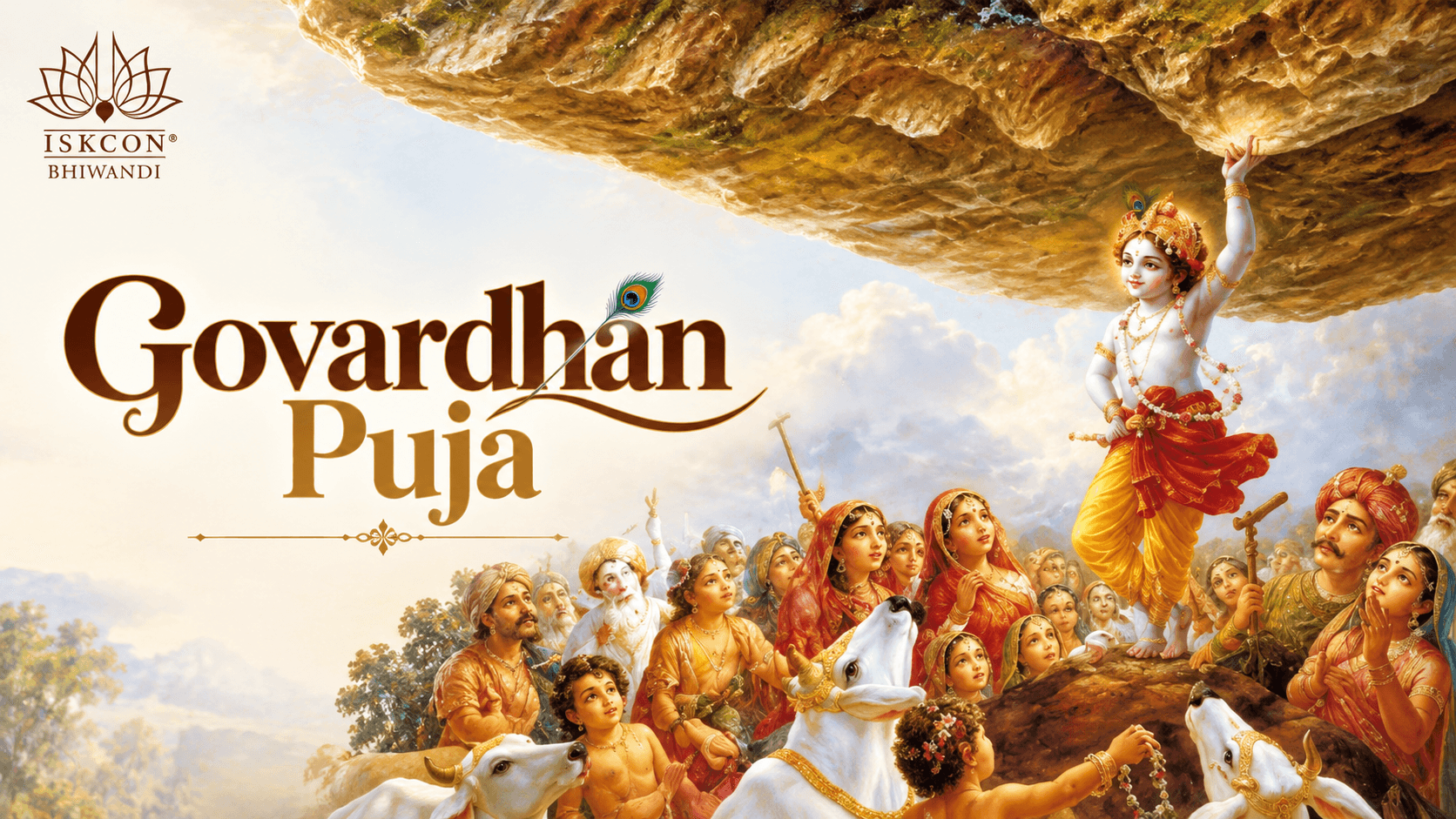
The day after Deepavali brings a beautiful reminder of Lord Krishna’s love for his devotees. On Govardhan Puja, devotees around the world remember the sacred pastime when Krishna lifted Govardhan Hill to shelter the people of Vrindavan. Also celebrated as Annakut, this joyful festival fills homes and temples with devotion, gratitude and an abundance of food lovingly offered to the Lord.
It reminds us to recognise Krishna’s grace in everything that nourishes and protects us. For families, it is also a precious opportunity to come together and introduce children to the values of faith, humility and thankfulness. In this blog, we explore the story and significance of Govardhan Puja, along with simple ways to celebrate Annakut at home with your loved ones.
What is Govardhan Puja / Annakut?
Govardhan Puja is observed on Kartik Shukla Pratipada, the first day of the waxing moon after Deepavali. It remembers how Krishna protected His devotees from Indra's anger by lifting Govardhan Hill on His little finger.
The festival is also called Annakut, which means "mountain of food." On this day, devotees prepare a large variety of foods, arrange them in the shape of a hill, and offer them to Krishna with love. In parts of Gujarat and Maharashtra, the same day also marks the start of the new year, known as Bestu Varas or Bali Pratipada, so it is a day of fresh beginnings as well as thanksgiving according to hindu rituals.
Govardhan Puja 2026 Date & Muhurat
Govardhan Puja date, tithi and Muhurat are mentioned below:
-
Date: 10th November, 2026
-
Tithi: Kartik Shukla Pratipada
-
Puja Muhurat: 3:46 pm to 6:02 pm[Can vary according to the place]
The pratipada tithi can stretch across two calendar days, so temples fix the exact day from the Vaishnava calendar. Please confirm the date before you plan your puja.
The Story of Govardhan Puja (Govardhan Katha)
The story of Govardhan Puja is mentioned below:
Krishna stops the worship of Indra
Every year, the residents of Vrindavan prepared a large offering to Indra, the king of heaven, to ask for good rain. One year, young Krishna saw the preparations and asked His father, Nanda Maharaja, why they were doing it. Nanda explained that it was an old tradition, and that Indra sends the rain that makes the crops grow.
Krishna replied with simple wisdom. The villagers were cowherds and farmers, and their cows grazed on the grass of Govardhan Hill, drank from its streams, and found shelter in its forests. So the hill, and not Indra, was their everyday provider. He suggested that they offer the feast to Govardhan Hill, to the brahmanas, and to the cows instead.
The villagers agreed. They cooked huge quantities of rice, dal, sweets and savouries, decorated their cows, and walked around the hill singing and chanting. Krishna then revealed a second form as Govardhan Hill itself and happily accepted the offerings, so the villagers were filled with joy and faith.
Krishna lifts Govardhan Hill
Indra was furious that his worship had been stopped. He sent terrible storms and flooding rain over Vrindavan, and the people and their cattle were frightened. They ran to Krishna and took shelter of Him.
With a smile, Krishna lifted Govardhan Hill with one hand and held it up like an umbrella, the way a child lifts a mushroom. He invited everyone to come under it with their cows and belongings. For seven days and seven nights, He held the hill without tiring while the villagers stayed safe and happy beneath it.
Indra finally understood that Krishna was no ordinary boy. He stopped the rains, came down with Surabhi, the divine cow, and bowed before Krishna. They bathed Him and named Him Govinda, the one who gives pleasure to the cows. This pastime is narrated in the Srimad-Bhagavatam, Canto 10, chapters 24 and 25.
Why Govardhan Puja Matters: Gratitude Over Pride
Govardhan Puja reminds us that everything we have is a blessing from the Lord. It teaches us to let go of pride and fear, and instead live with gratitude, faith and a heart that remembers His grace. Indra's pride was broken, and Krishna's devotees were protected, which shows that sincere devotion matters more than ritual done out of habit.
The festival also teaches us to respect nature and the cows that provide for us. The hill, the grass, the water and the cows were all part of the villagers' daily life, and Krishna asked them to recognise their value. Above all, it reminds us that Krishna always takes care of those who take shelter of Him.
Annakut: The Mountain of Food Offered to Krishna
On Annakut, temples offer a large spread of rice, sabzis, dals, breads, sweets and savouries, often 56 items or more, arranged in the shape of a hill. This remembers the feast the villagers offered to Govardhan. After it is offered, the food becomes prasadam and is shared with everyone who visits. You can be a part of this offering by sponsoring annadaan seva at the temple.
Devotees believe that offering food with love is more important than the quantity or the cost. A simple dish offered with devotion pleases Krishna just as much as a grand feast.
How to Celebrate Govardhan Puja at Home (Puja Vidhi)
You do not need elaborate arrangements to celebrate at home. Follow these simple steps:
-
Clean and decorate. Clean your puja area and decorate it with flowers and rangoli.
-
Make Govardhan. Make a small hill out of cow dung, clay, or even a mound of sweets or rice, and decorate it with flowers and tulsi leaves.
-
Prepare the offering. Cook simple vegetarian dishes without onion or garlic. Even a few dishes, offered with devotion, are perfect.
-
Offer to Krishna. Place the food before Krishna's picture or deity, offer incense and a ghee lamp, and offer the food with prayers. You can also support daily deity worship at the temple, or book an online puja if you cannot visit.
-
Go around the hill. Walk around your Govardhan hill (parikrama) while chanting the Hare Krishna maha-mantra.
-
Honour the cows. If possible, feed cows the grass, fruit or chapatis.
-
Share prasadam. Distribute the prasadam to family, neighbours and friends.
Involve children in making the hill and decorating the offering. It is a lovely way to teach them the story.
Govardhan Puja Celebration at ISKCON Bhiwandi
Join us at Sri Sri Radha Madhava Mandir, ISKCON Bhiwandi and Annakut festival, with kirtan, abhishek, Annakut darshan, a talk on the pastime, and prasadam for all.
To take part in the festival seva, please visit The Kartik Maas page.
FAQs
Is Govardhan Puja the same as Diwali?
No. Govardhan Puja is a separate festival celebrated the day after Deepavali. It is the fifth day in the multi-day Deepavali celebrations and honours Krishna lifting Govardhan Hill.
Is fasting required on Govardhan Puja?
No fast is required. It is a feast day, and devotees happily take Annakut prasadam after the offering.
Why do devotees worship cows on Govardhan Puja?
Krishna is called Govinda and Gopala because He loves and protects the cows. The cows of Vrindavan sheltered under the hill with everyone else, so devotees bathe, decorate, and feed cows on this day to show gratitude.
What should devotees chant or read on Govardhan Puja?
Devotees chant the Hare Krishna maha-mantra and sing the glories of Giriraj Govardhan. You can also read Srimad-Bhagavatam, Canto 10, chapters 24 and 25, which describe the pastime.